


“every…Bernd and Hilla Becher Prison type Gasholders” Idris Khan 2004.
“every…Bernd and Hilla Becher Spherical type Gasholders” Idris Khan 2004.
Working with appropriated imagery, Idris Khan’s photos are all-encompassing composites, consolidating iconic cultural symbols of similar type into single ‘super-images’. In this selection of his every… series, Khan aggregates the work of renowned artists Bernd and Hilla Becher, famous for their vast photographic collections of buildings and industrial sites. Exposed in translucent layers, anchored by the compositions’ continuous shapes, the Becher’s gasholders and gabled houses loose their commanding simplicity and rigid formalism, descending into fractured and gestural blurs merely suggestive of the originals. Through this process of layering, Khan creates a poetic malleability from the fixed codes of history. Compressing the timeline of repetition into indivisible subsuming moments, his photos offer a glimpse into the sublime.Meggan Gould
Artist Website
The series Go Ogle by photographer Meggan Gould takes the first 100 responses to a Google image search, then overlays those 100 images into a single photographic "average."
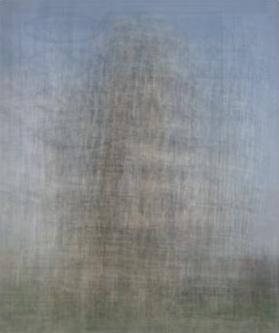
[Image: leaning+tower+pisa].
As Gould herself writes:
"The results, a visualization of intersections between Boolean logic and the popular imagination, are more often than not a hopeless jumble of unidentifiable pixels – but occasionally a recognizable form does emerge." See animation.
"Word choice, spelling, and textual hints are all critical to conducting an effective search, and the averages reflect their importance: a search for coke+can reveals a crisp, almost legible average, whereas coca+cola+can is muddy and barely recognizable. Truly iconic imagery is elusive, particularly considering the glut of computer graphics through which internet spiders and archivers crawl daily; only a small fraction of searches retains any degree of legibility through the averaging process."
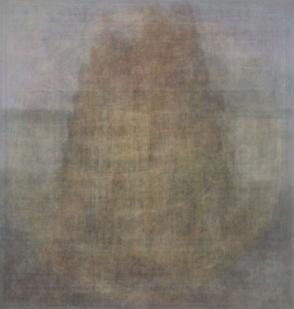
[Image: tower+babel].
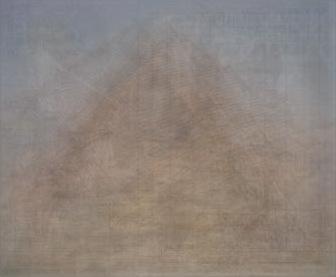
[Image: pyramid+giza].
Jason Salavon
Artist Website
Working around art, information technology, and daily life.
Using software processes of his own design, Jason Salavon generates and reconfigures masses of communal material to present new perspectives on the familiar. Though formally varied, his projects frequently manipulate the roles of individual elements arranged in diverse visual populations. This often unearths unexpected pattern as the relationship between the part and the whole, the individual and the group, is explored. Reflecting a natural attraction to popular culture and the day-to-day, his work regularly incorporates the use of common references and source material. The final compositions are exhibited as art objects, such as photographic prints and video installations, while others exist in a real-time software context.
Born in Indiana, raised in Texas, and based in Chicago, Salavon earned his MFA at The School of the Art Institute of Chicago and his BA from The University of Texas at Austin. His work has been shown in museums and galleries around the world. Reviews of his exhibitions have been included in such publications as Artforum, Art in America, The New York Times, and The Wall Street Journal. Examples of his artwork are included in a number of prominent public and private collections. He has taught at The School of the Art Institute of Chicago and was employed for numerous years as an artist and programmer in the video game industry.

The Late Night Triad 2003
Part I: The Tonight Show with Jay Leno
Part II: Late Night with Conan O'Brien
Part III: Late Show with David Letterman
3 Synced single-channel DVD projections
Running time: 3 min 35 sec looped. Dimensions variable. Ed. 3 + 1 APs.
In this installation, from a broader series begun in 1997, 64 nights' worth of the major US late night talk shows have been aligned and averaged using basic transformations. The result is a triptych of video projections with soundtrack, presenting an amalgamation of monologues which reveals the ghosts of repetitious structure and nightly activity.
________________________________________________________


The 1960s The 1990s
Every Playboy Centerfold, The Decades (normalized) 2002
Digital C-prints
60" x 29.5" ea. Ed. 5 + 2 APs
From a broader series begun in 1997, the photographs in this suite are the result of mean averaging every Playboy centerfold foldout for the four decades beginning Jan. 1960 through Dec. 1999. This tracks, en masse, the evolution of this form of portraiture.

No comments:
Post a Comment